Named guides, each with its date
Milwaukee Foundation Repair Cost: Published Ranges and What Moves Them
Foundation repair cost in Milwaukee depends less on the city than on the house: a 1925 duplex with a finished lower flat, a 1955 ranch on clay, a stoop that was poured on shallow fill. No public agency publishes what Milwaukee contractors charge, so the table uses national cost guides, each named with its year.
Most foundation repairs fall between $2,200 and $8,200 in Fixr's 2026 guide, averaging $5,200. HomeGuide's figures: wall anchors $80–$150 per foot (2025), interior drain tile $4,000–$17,000 (2026), a sump pump $600–$2,500 installed (2023).
Foundation and basement repair prices to check a Milwaukee bid against
| Repair | Guide and year | Range in the guide | Why a Milwaukee bid may differ |
|---|---|---|---|
| Foundation repair, all types | Fixr, 2026 | $2,200–$8,200; average $5,200 | Which repair below it turns out to be |
| Injecting a single crack | HomeGuide, 2026 | $250–$800 | Suits poured walls; block leaks at the joints |
| Wall anchors | HomeGuide, 2025 | $1,600–$3,000 per 20-ft wall ($80–$150 per linear foot) | Room in the side yard on a narrow lot |
| Carbon fiber or steel straps | HomeGuide, 2025 | $1,700–$5,600 per 20-ft wall ($85–$280 per linear foot) | How far the wall has already moved |
| Carbon fiber strips, whole job | Fixr, 2026 | $4,000–$12,000 | Number of walls and their length |
| Helical tiebacks | HomeGuide, 2025 | $300–$360 per linear foot | Bowing of 2 inches or more |
| Excavating and straightening a wall | HomeGuide, 2025 | $6,800–$11,000 per 20-ft wall ($340–$550 per linear foot) | Frozen ground, walks and the house next door |
| One pier under a footing | Fixr, 2026 | $1,000–$3,000 | Depth to firm till below soft or filled ground |
| Helical piers, per pier | HomeGuide, 2025 | $2,000–$4,000 | How many a corner or stoop needs |
| Settling or sinking foundation | HomeGuide, 2026 | $4,500–$20,000 | Pier count and work inside a finished unit |
| Underpinning a foundation | HomeGuide, 2025 | $10,000–$30,000 or more | Whole walls rather than one corner |
| Slab jacking a stoop or slab | Fixr, 2026 | $500–$1,900 | Whether frost will lift it again |
| Interior drain tile with a sump | HomeGuide, 2026 | $4,000–$17,000 | Basement perimeter and a finished lower flat |
| Exterior waterproofing | HomeGuide, 2026 | $10,000–$18,000 | Depth of the dig and space between houses |
| Sump pump: new / swap | HomeGuide, 2023 | $600–$2,500 new; $400–$700 to swap; $2,500–$5,000 if the floor is cut | A new pit in an old concrete floor |
| Regrading next to the foundation | HomeGuide, 2026 | $1,000–$5,000 | Lots that tip toward the foundation |
| Structural engineer's report | HomeGuide, 2026 | $500–$3,000 | A site letter or a full repair design |
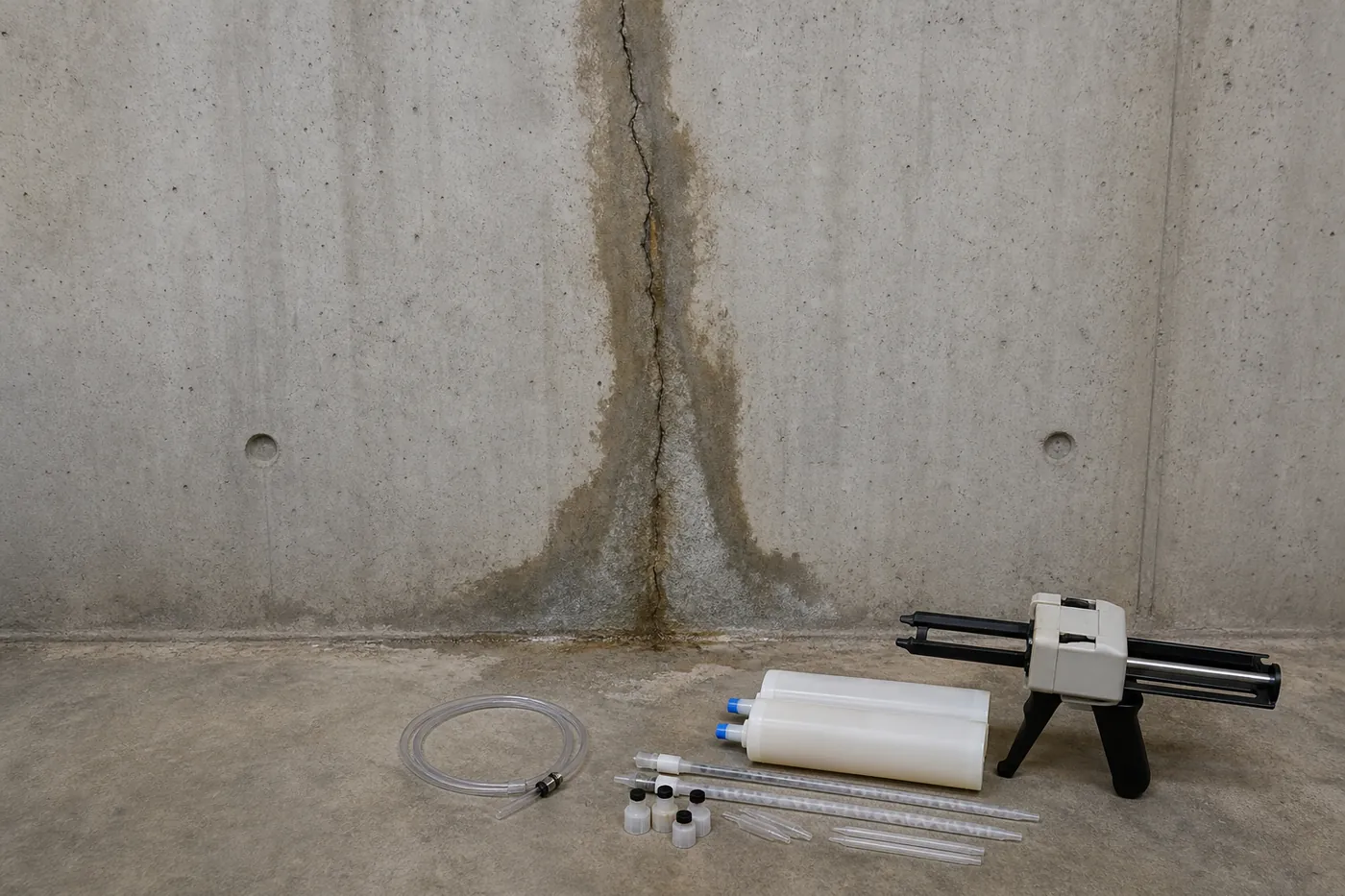
Which details raise foundation repair cost on a Milwaukee house?
- A finished lower flat. In a duplex or Polish flat the basement walls may be someone's living room. Paneling, cabinets and flooring come out before any wall work and go back after.
- Clay backfill. An excavation in stiff clay is slow, and Wisconsin's code calls high-plasticity clay unsuitable as backfill, so a dig may need new fill brought in.
- Winter. NOAA's normals for Milwaukee Mitchell Airport show about 50 days a year that never rise above freezing. Digging outside is slower then, so find out whether a January start costs more than a May one.
- Narrow side yards. An anchor plate has to sit in firm, untouched soil some distance from the wall. If the house next door or a driveway is in that spot, bracing from inside is what remains.
- Two jobs at once. A bowed wall with water behind it usually needs drainage too, and doing both together avoids opening the wall twice.
Permit, contractor and license lines
Nationally, Fixr's 2026 guide lists permit fees of $75–$150. Milwaukee charges its own schedule, so the permit should appear as its own line on a bid. The city's permit checklist marks basement alterations as probably needing one and all plumbing work in a house as needing one. In Wisconsin, a building permit for a one- or two-family home goes only to a holder of a Dwelling Contractor certification who also holds or employs a certified Dwelling Contractor Qualifier, unless the owner who lives there applies. The city adds that contractors must be licensed with the state and with the City of Milwaukee.
Reading a waterproofing bid under Wisconsin rules
Wisconsin treats basement waterproofing as a special case. Under ATCP 110.09, the seller must hand you a signed seller's analysis, a written statement of what is causing the water and exactly which methods and materials will fix it, before the contract is signed. Any guarantee must be in writing first, and if the work carries no guarantee, the contract must say so in bold type. Compare bids on that analysis, not only on the total. The methods themselves are on the basement waterproofing page.
Ways to keep the bill down
- Start outside. Downspout extensions and regrading cost a fraction of a drain system: HomeGuide (2026) prices replacement downspouts at $220–$625 for a house and regrading at $1,000–$5,000.
- Ask about city programs. In neighborhoods it has targeted, Milwaukee's Department of Public Works has disconnected foundation drains and lined sewer laterals at no cost to residents, with funding from the Milwaukee Metropolitan Sewerage District.
- Price the method, not the brand. Ask each bidder for the count of anchors or strips and their spacing, so two bids can be lined up.
- Get the engineer's letter first on a wall that has moved a lot. HomeGuide (2026) puts a report at $500–$3,000, and a design you commission is not tied to one company's product.
Cost questions
Is carbon fiber cheaper than wall anchors in Milwaukee?
Per foot, they overlap. HomeGuide (2025) lists anchors at $80–$150 a foot and steel or carbon fiber straps at $85–$280 a foot. Carbon fiber goes on from inside, so it suits a wall with no room outside for anchor plates, but it holds a wall where it is rather than pulling it back. Bowing of 2 inches or more usually calls for something heavier.
Why did one bid include drain tile when I asked about a cracked wall?
Because water and wall movement are linked. Wet clay pushes harder and freezes, so many specialists pair wall bracing with drainage. That can be good advice, but ask the bidder to price the two parts separately and to explain in writing why the drainage is needed. For waterproofing, Wisconsin rule ATCP 110.09 requires a written seller's analysis before you sign.
Are winter foundation repairs more expensive in Milwaukee?
Outside work can be. Frozen clay is slow to dig, and Wisconsin's code bars placing footings on frozen material, so excavations, new footings and anchor plates may be priced higher or held until spring. Inside work, such as carbon fiber, steel beams, an interior drain or a sump, is affected far less. Have each bidder put any seasonal surcharge or start date in writing.
Tell us what the basement is doing
A crack you have been watching, water after a storm, a stoop leaning away from the house: a sentence or two is enough. It goes to one independent foundation and waterproofing specialist who works in Milwaukee.