Bowed Basement Wall Repair for Milwaukee Block and Brick Walls
Bowed basement wall repair in Milwaukee mostly means a concrete block wall with a horizontal crack a few courses below the top, or an older brick wall that has bellied inward. The push comes from wet, clay-rich soil outside. The fix depends on how far the wall has moved and how much room there is outside.
HomeGuide (2025) prices wall anchors at $80–$150 a foot and steel or carbon fiber straps at $85–$280 a foot for walls bowed under 2 inches. Walls bowed 2 inches or more move to tiebacks ($300–$360 a foot) or excavation and straightening ($340–$550 a foot).
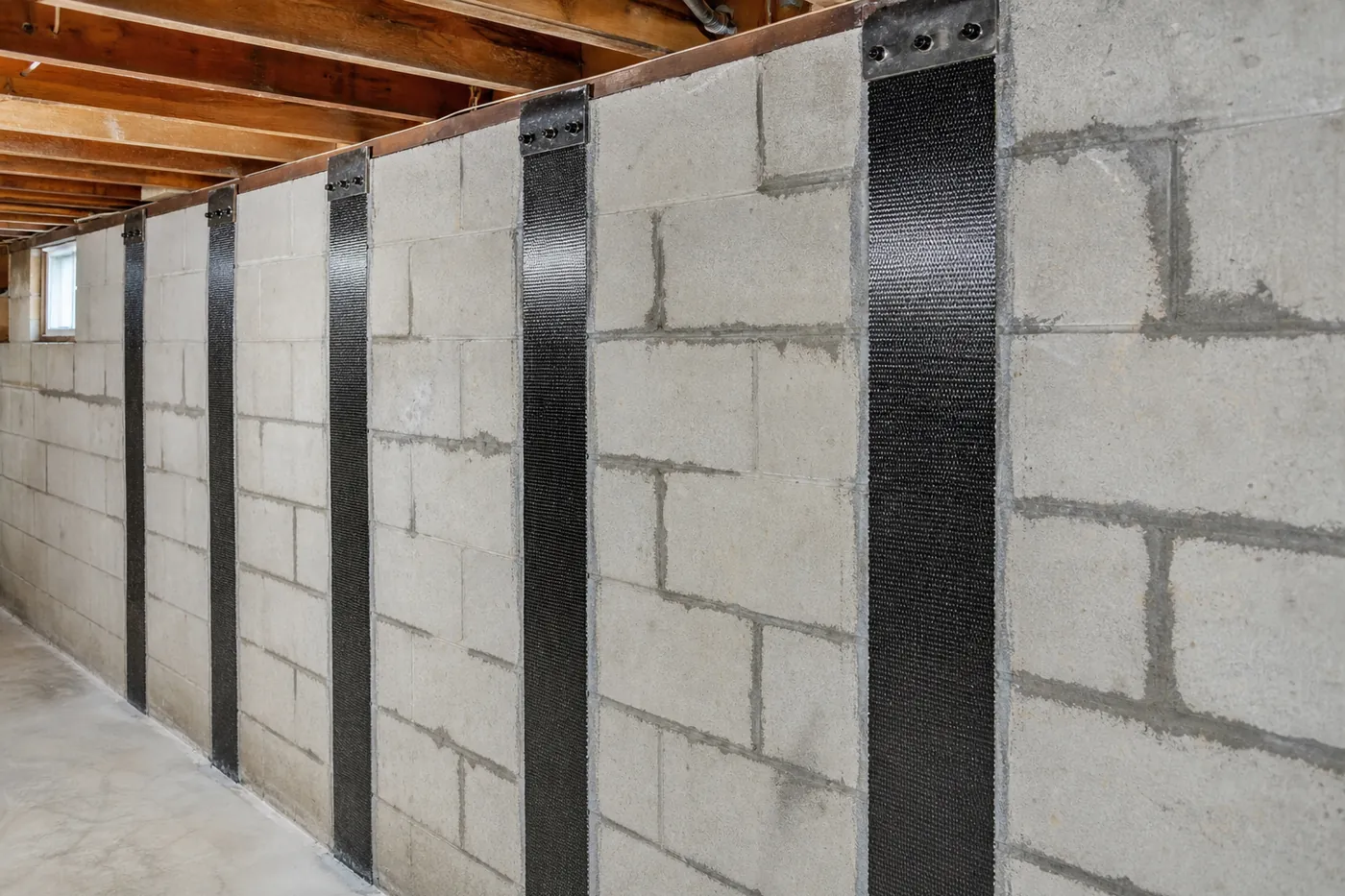
What makes a Milwaukee block wall bow inward?
Soil load, water and frost, in that order. Wisconsin's dwelling code rates the sideways push of low- to medium-plasticity clay at 60 pounds per square foot for each foot of depth, double the figure for clean gravel, and adds the full water pressure when soil is saturated. Block walls are courses of hollow units held by mortar, so they bend at a joint: usually a horizontal crack near mid-height, sometimes stair-step cracks running to the corners. Current code calls for block walls to be parged and dampproofed outside from footing to grade, which is worth asking about whenever a wall is dug out.
Bowed basement wall repair options, side by side
- Wall anchors: a plate inside the basement is bolted to a rod that runs out through the wall to a buried earth anchor; the nut is snugged up a little at a time. The yard has to have room for the anchors. HomeGuide (2025): $80–$150 per foot, spaced about 5 feet apart.
- Carbon fiber straps: bonded to the inside face and tied to the floor and the framing above. Thin and quick, and they hold the wall where it is. HomeGuide (2025): $85–$280 a foot for straps; Fixr (2026): $4,000–$12,000 for a typical carbon fiber job.
- Steel beams: vertical I-beams fixed at the floor and to the joists, for walls with some movement and no room outside.
- Helical tiebacks: screwed at an angle into firm soil, for heavier bowing. HomeGuide (2025): $300–$360 a foot.
- Excavate and straighten or rebuild: the wall is exposed, pushed back or relaid, then parged, dampproofed and drained before backfill. HomeGuide (2025): $340–$550 a foot.
How do you know the wall is still moving?
Measure it, then measure again. Stretch a string or hold a long level against the wall and note the gap at the widest point. Pencil the crack ends with the date. Check after the spring thaw and again in fall. Growth between readings, or a bottom course that has slid inward, means it is time for a specialist and perhaps an engineer: HomeGuide (2026) prices a structural engineer's report at $500–$3,000. If readings stay the same for several years, better drainage and periodic checks may be all it needs.
Permits, credentials and paperwork
The City of Milwaukee's permit checklist does not list wall repair by name, so ask the contractor to confirm with the Permit and Development Center and to pull any permit itself. When a building permit is needed for a one- or two-family home, Wisconsin requires whoever obtains it to hold a Dwelling Contractor certification, unless the resident owner applies, and the city says contractors must also hold a City of Milwaukee license. Ask for both numbers. Every method's range is on the Milwaukee foundation repair cost page.
Questions homeowners ask
Will carbon fiber straighten my bowed wall?
No. Carbon fiber straps are designed to stop a wall from moving further, not to pull it back. Anchors can be snugged up gradually over several seasons, and digging the wall out allows it to be pushed back or relaid. For a wall bowed less than 2 inches that has stopped moving, holding it in place is often enough. Ask the specialist what each method can and cannot do.
Tell us what the basement is doing
A crack you have been watching, water after a storm, a stoop leaning away from the house: a sentence or two is enough. It goes to one independent foundation and waterproofing specialist who works in Milwaukee.